Evidence-grounded investigative AI for law enforcement. Turn a 100,000-document case into a searchable, cited workspace — running entirely inside your CJIS boundary, where the AI cites the underlying evidence instead of guessing.
Motive. Financial dispute — Tanner told his girlfriend he was going to “settle things” with Wilson over a ~$15,000 debt Incident Report — Det. Santos. A driveway altercation a week earlier was witnessed by neighbor Michael Chen Witness Interview — M. Chen.
Contradictions. Wilson describes friendly drinking; Chen reports ~30 minutes of heated shouting about money Witness Interview — M. Chen. Wilson says shots ~11:15 PM; the 911 call logged 11:45 PM — 15–30 minutes unexplained Witness Interview — J. Wilson (POI).
The evidence isn’t the bottleneck — reading it is. CaseLead turns a case into a working investigative surface: AI-surfaced leads, timeline gaps, a review queue, and evidence — every item grounded in the record and sized to real caseloads, including large cold cases.
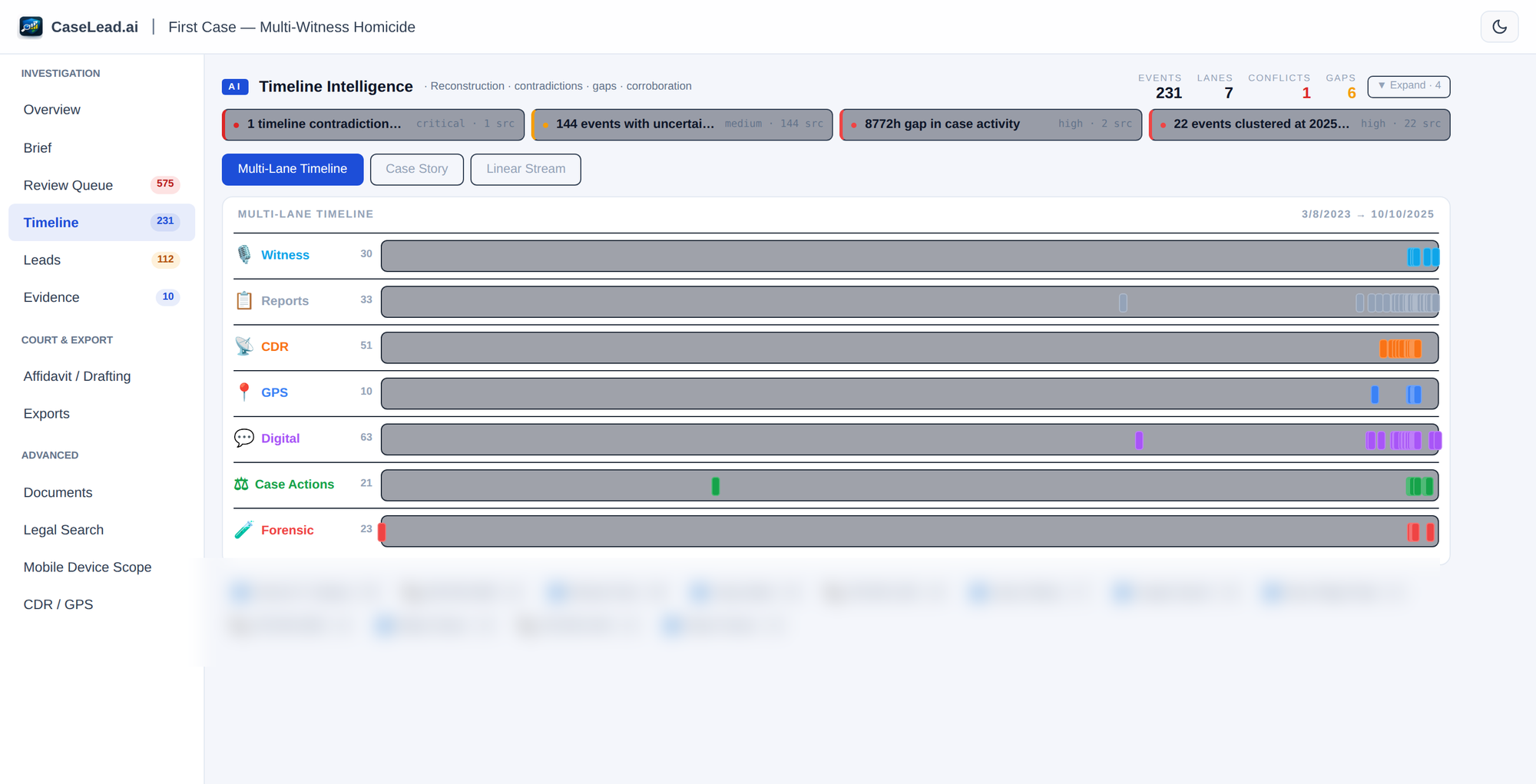
Multi-lane timeline intelligence — CaseLead reconstructs the case across evidence lanes and flags contradictions, gaps, and clusters, each traceable to the record. Live counts, 231 events, one open workspace.
Bring the case file into one place — then search it, question it, and shape it into timelines, relationships, leads, and documents.
Ask questions in plain language. Answers come from the indexed case file — reports, transcripts, media, entities, timeline — with the sources attached.
Keyword and meaning-based search across everything ingested — so a detail phrased three different ways in three different reports still surfaces.
See the whole case on one timeline in minutes. Every date and statement scattered across thousands of pages becomes one coherent sequence — each entry clickable to its source, gaps and conflicts flagged.
People, phones, vehicles, addresses, and organizations — extracted from the record and connected, so the network around a case becomes visible.
Surface the leads buried in the file. CaseLead flags people, connections, and gaps a unit could take months to reach — every lead shown with the evidence it rests on, never a conclusion. Your team reviews, prioritizes, and dispositions.
Affidavits, warrant language, preservation requests, summaries — drafted from the case record to a working first pass, finished and owned by you.
The difference between investigative AI you can use and AI you can't is one thing: whether every answer can be checked against the record.
Your question runs against the indexed case file. The system finds the actual passages that answer it — it doesn't free-associate from a model's imagination.
Every finding carries links to the specific document, page, or transcript it came from. Verification takes seconds, not an afternoon.
CaseLead never designates suspects and never draws legal conclusions. Investigators review, verify, and disposition everything the system surfaces.
The result: an investigator can ask any question of the entire case and get an answer they can defend in court — because every word traces to the record, and the original evidence is never altered.
These are rules the platform is built around — read the full Responsible AI statement.
No synthetic benchmarks. One active major-crime file, processed end to end on desktop-class agency hardware — and every figure reproducible on your own case during evaluation.
CaseLead runs today on an active major-crime file of 128,000+ documents — the kind of case that takes a unit months to re-read. CaseLead indexed all of it into 1.8 million searchable, cited passages — roughly 300,000 entities and 340,000 timeline events — end to end on agency hardware, and answers questions across the full record in ~17 ms. Measured, not projected. How these numbers were measured →
Don’t trust our numbers — regenerate them. Every figure is reproducible on your own hardware, with your own case, during evaluation.
Cloud for the demo, on-premises, or fully air-gapped for criminal justice information — and in every model, the record is handled the way your evidence room would handle it.
CaseLead runs fully air-gapped on your hardware, inside your CJIS boundary, with fail-closed egress controls — no cloud, no third-party model API, no data ever transmitted. Your evidence stays exactly where the law says it must.
CJIS compliance is a property of a whole deployment — hardware, network, personnel, policy — not of any one product. CaseLead is built to operate inside a CJIS-compliant environment and to make that the default.
Read the security whitepaperFor a fully air-gapped deployment, the agency provides the hardware and CaseLead runs entirely on it — inside your walls, no internet, no cloud, every byte of processing on-device. Size it to your caseload.
Representative tiers — we right-size with you. Every option runs 100% on-device: no internet, no cloud, no data egress.
Start a 30-day evaluation inside your CJIS boundary, on a case you choose. We'll show you the leads it surfaces — and you keep the validation report. Hardware is flexible: run it on equipment you already have, put an entry-tier workstation through standard acceptance testing, or begin with a cloud pilot on de-identified data. We'll scope it with you. Prefer a walkthrough or the demo access code first? Same form; just say so.
 CaseLead